

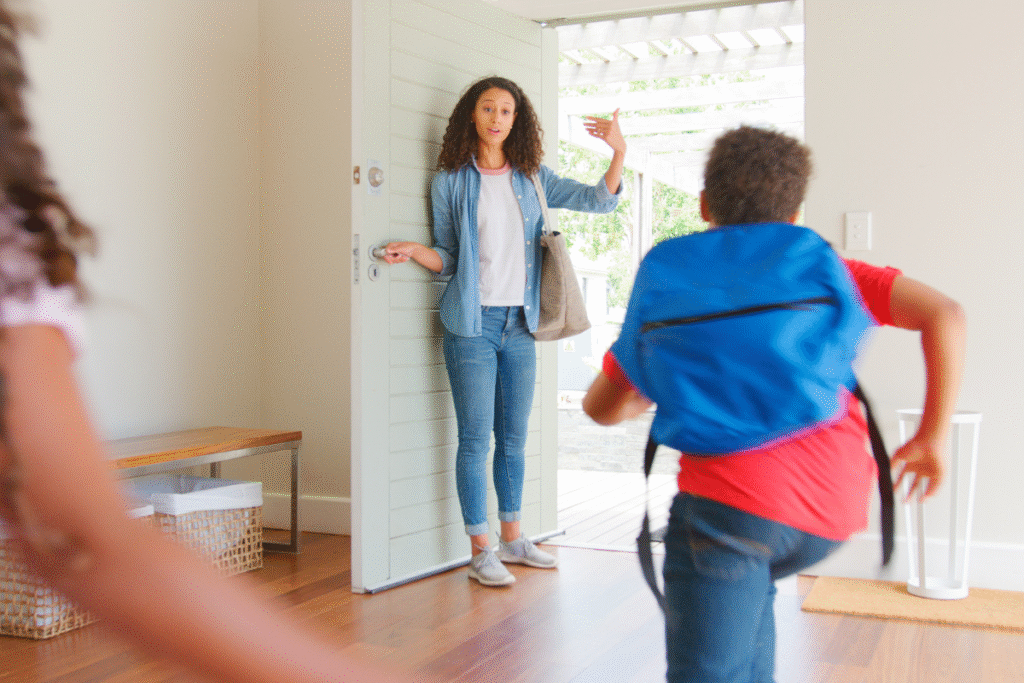
Expert advice on how to take the ‘mad’ out of the mad dash in the morning.
Weekday mornings can be one of the most hectic, most anxiety provoking and most anger-inducing times of the day. Sometimes it feels like getting your kid(s) and yourself out the door is like trying to beat a ticking time-bomb. Inevitably, you end up exhausted and stressed out before your day even starts!
It makes sense – there is not a lot of wiggle room on weekday mornings.
First, there is a hard deadline. Everyone has to be out the door by a specific time. To catch the bus. To make the bell. To be at the office. This can feel like the timer on a bomb. Beat the timer – ah, bomb defused. Miss the deadline – boom! Tears, contingency plans, perhaps even lost wages. Most of the time there is no wiggle room on this.
Second, there is a pretty specific and non-negotiable list of things to get done before that timer goes off. Clothes on. Breakfast eaten. Teeth brushed. Lunches made. Backpacks packed. Coats and shoes on. Not to mention the extras. Forgotten forms to be signed. Quick review of test material, etc., etc. Most of the time there is no wiggle room on this either.
So, let’s just start with the suggestion that if you are new to teaching your child skills, do not start here. The morning routine is such a pressure-cooker situation that you may want to focus simply on the ‘prepare’ strategies for a while.
Taking a few moments ahead of time to prepare for interactions with our kids will actually save time and frustration in the end. And much of this preparation is mental preparation – not time taken to buy, make or create things. Based on our experience and the research on child development and learning, we have found the following strategies to be highly effective in supporting kids to do the next right thing:
Pare it down: be realistic and pick your battles.
Be clear: spell it out, offer choices and provide a ‘heads-up’.
Give like a grandparent: be nice about it, provide freebies and catch them being good.
Do everything in your power to set your kid up for success in the morning (and yourself) by helping them with most of the routine. Help them to get dressed. Make their breakfast. Pack their bags, etc. Consider some additional “prepare” strategies that will help for now, such as packing lunches, having weather-appropriate clothing items ready and having breakfast items on the table the evening before.
The first step
The ‘morning routine’ is actually a complex set of activities and choreographed dances.
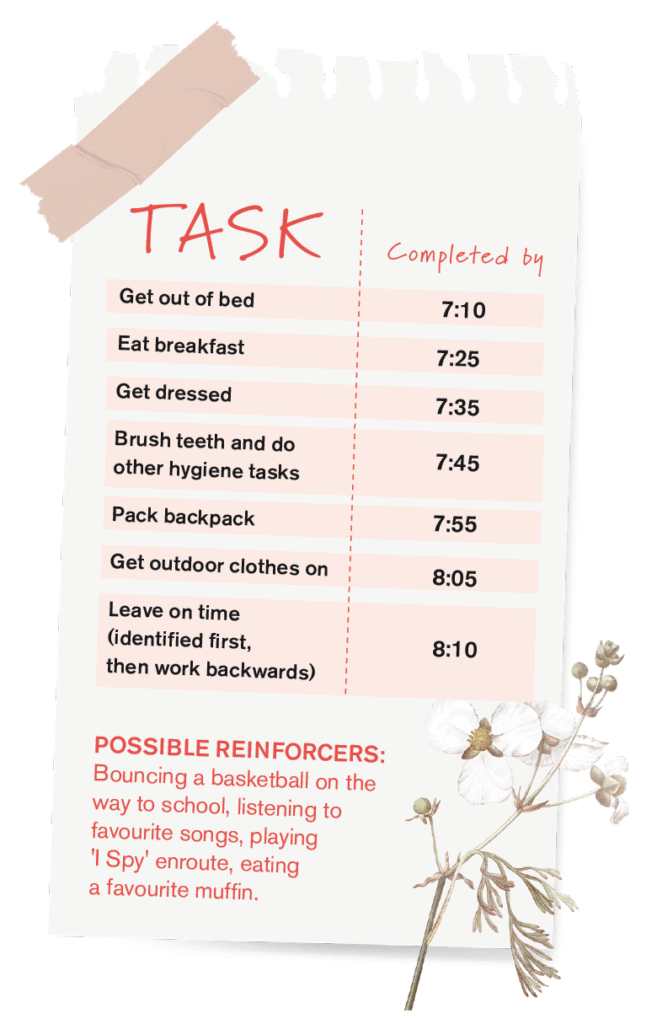
The first step in the process of teaching your child to be independent with their morning routine will be to define what each task is. What are the tasks that need to get done, in what order and by what time? Be sure to define them clearly.
The routine might look something like this:
- Get out of bed
- Eat breakfast
- Get dressed
- Brush teeth and complete other hygiene tasks
- Pack backpack
- Get outdoor clothes on
- Leave on time (be specific about what time you need to be out the door)
The second step
The second step is to be a ‘skills detective’. Evaluate, of these tasks, which ones your child can do on their own, or with help, or with complete assistance.
Consider whether your child needs some additional reminders for certain steps. For example, some children may benefit from having a checklist of hygiene tasks that needs to be completed (teeth brushed, hair brushed, deodorant on, medication taken, etc.). Others might need a backpack checklist (lunch, notebooks, gym clothes, etc.) or an outdoor clothing list (boots, jacket, etc.). This is where you can be very specific as to what your child needs to do depending on their age, the season or where you live. In some climates, there is a big difference between getting dressed to leave the house in January and in June. Be realistic about how long things take.
If you realise there are several tasks your child cannot yet do on their own, we suggest you teach them at another time. This is about teaching them how to smoothly follow a morning routine in a timely manner that gets everyone out the door on time and with as few tears, meltdowns and/or arguments as possible.
For example, if your child cannot fully dress themselves, teach and practise this with them on weekends and on holidays when you are both relaxed and not under time pressure. This can also be practised at times other than the mornings. Until your child is able to get themselves dressed, be there to help them get dressed on weekday mornings.
The third step
Finally, evaluate how long it takes your child to do each step. The third step will be to make a visual schedule that includes the times by which each task needs to be completed. Work backwards from the time you actually have to be stepping out the door in order to get to school/work on time and assign each task a ‘complete by’ time.
The fourth step
The fourth and final step is to end this whole process with a reward. For example, if we can get out the door on time, we can listen to your favourite music in the car. If we can be ready by _ time, we can stop at the local donut shop for a treat. If we get out the door by ___ time, you and I can play that fun version of ‘I Spy’ as we walk. Get creative about what will motivate your child. Mix it up and have fun!
We know that providing rewards as soon as possible after the desired behaviour is most successful in increasing the behaviour we want to see. So we do not advise you use reinforcers that can only be given after school.
After school is a long way away. Lots of road has been covered by the time they get home from school. If they earned their reward in the morning but did not receive it and then proceeded to have a bad day, you may not feel it is ‘right’ to reward them. If you go ahead and give them their reinforcement, you may worry that you have reinforced the ‘wrong’ behaviour.
Either way, the reward will lose its power to increase the likelihood of a smooth sailing morning the next day.
Putting it into practice
Take out a journal and write what your child’s morning routine would look like. First, fill in the time you need to be out the door. From there, working backwards, identify the times to have certain tasks completed by. Ensure the time you have written is of reasonable length.
Make a list of possible reinforcers your child can earn and get in the morning. Better yet, make the list in collaboration with your child.
Make sure these are rewards they can get/do in the morning after they have completed their tasks.
Putting it all together
As your child becomes more skilled at executing the various parts of the various tasks, you will start to ‘fade’ out your support strategies. The visual schedule for dressing may no longer be needed. The backpack checklist gets a quick glance. But remember, you never want to fade out the reinforcement completely.
Let us repeat. You never want to fade out the reinforcement for getting out of the house on time. What you can do is switch up what the reinforcement is, and how often you give it. Now would be the time to build in surprise rewards – pizza party at the end of the week, the coffee shop stop, access to more screen time on the weekend, etc.
Voilà. Bomb defused. Everyone starts their day with a smile.