
Kids are curious, playful, and full of energy, and we love that. But public spaces bring different expectations, and kids aren’t born knowing how to navigate them. Learning how to “behave” in public is one of those long-game parenting lessons. It takes time, gentle repetition, and a healthy dose of perspective.
Why Kids Get It “Wrong”
Here’s something that helps: some behaviours that look like disobedience are actually developmental. Kids aren’t trying to be rude when they run up the slide or start shouting in a quiet space. They’re still learning that different contexts require different behaviours. Psychologists call this discrimination (not the prejudice kind, but the ability to tell the difference between two settings and respond accordingly).
This skill develops gradually. It can be especially tricky for kids who are neurodivergent, anxious, or struggle with transitions.
At the Playground
The backwards slide climber
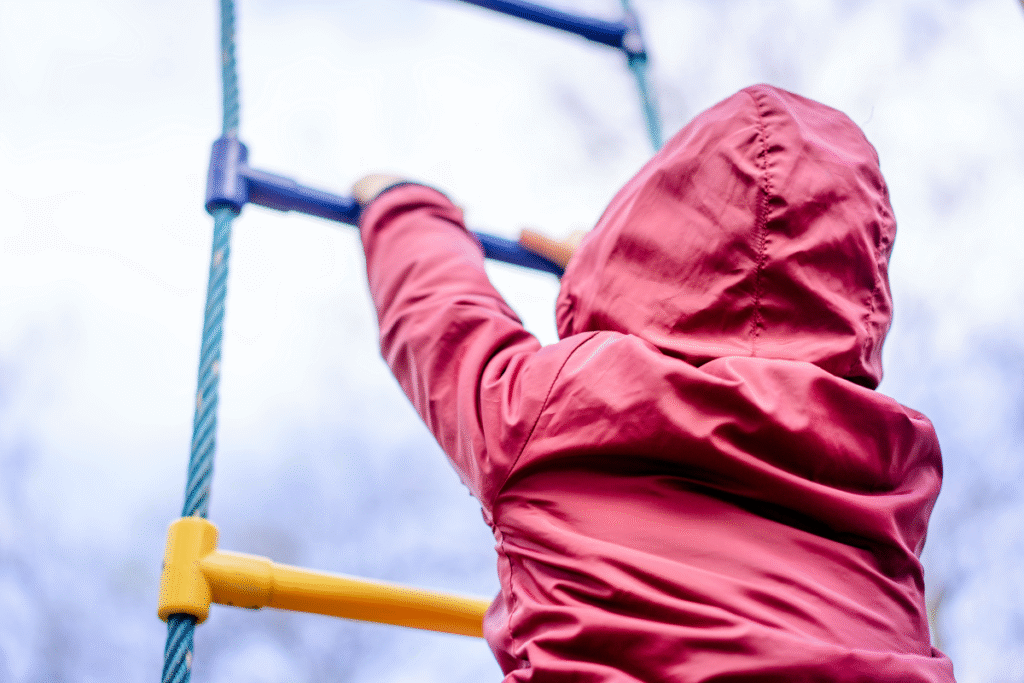
You know the one. Climbing up the slide while others are waiting to go down. It feels adventurous and rebellious, and if no one’s on the slide, it’s usually fine. But when there’s a line of kids nervously trying to take their turn, climbing up creates traffic, tension, and someone might get kicked in the face.
Try: “The slide is like a one-way road. We wait our turn to go down, and we climb on the ladder instead.”
The oblivious camper
Kids get so caught up in their own play that they don’t notice others waiting. Hanging out at the top of a climbing frame pretending it’s a pirate ship? Totally age-appropriate. But if three kids are waiting with anxious eyes and nowhere else to play, it’s time to move along.
Try: “Looks like others are waiting. Let’s give them a turn and find something else for now.”
The uninvited player
When kids want to join a game with strangers, it’s easy to forget there are social steps involved. Some kids barrel in with “I’m the monster!” before anyone knows who they are. Sometimes, this can cause friction, but it’s also a great learning opportunity.
Try: Practice saying “Can I play too?” and prepare them for both answers (yes and no) so they know how to respond without taking it personally.
In Cafés and Restaurants
Kids often struggle with volume control and staying in their seats. You might be mid-sentence in a conversation and suddenly your child is under the next table, barking like a dog. It’s not bad behaviour. It’s restlessness, excitement, boredom, or all three.
What helps:
- Have a quick chat about expectations before you go in: “Remember, this is a café where people come to have quiet conversations. We’ll use our indoor voices and stay at our table.” Keep it simple and specific.
- Bring a quiet activity they can do at the table (colouring, stickers, a small fidget toy). Get it out before they start getting restless, not after.
- Offer a concrete reward if they manage it well: “If we can have a calm lunch, we’ll stop at the park on the way home” or “You can choose a treat from the bakery if you use your restaurant manners.”
- Sometimes when kids are kicking their legs wildly under the table, they’re not being naughty, they just need some sensory input or calming contact. Try placing a gentle hand on their knee or leg. It can be surprisingly grounding.
- Set a gentle physical cue like tapping your chin as a subtle reminder to bring the volume down, or a hand on their shoulder as a “settle” signal.
- If they’re getting squirmy, sometimes a quick trip to the bathroom or a walk outside to “check something in the car” can reset their nervous system before things escalate.
- Give them a role: “Can you be in charge of passing out the napkins?” or “Let’s see if you can count how many blue things you can spot from our table.” It channels their energy into something constructive.
Trip hazards
That bag flung on the ground might not seem like a big deal, but it’s a tripping hazard for someone carrying hot drinks or with mobility needs. A simple “Let’s tuck your bag under your chair so nobody trips” usually does the trick. You might need to remind them every single time for a while, and that’s normal.
At the Supermarket
A supermarket aisle is not a race track, though it definitely feels like one to a bored five-year-old. The key is giving them something to do.
What works:
- Give them small jobs: “You’re in charge of picking the yoghurt,” or “Can you find three red things we need?”
- Let them push a small trolley or basket if the shop has them (warning: this can also backfire spectacularly)
- Play counting games: “Let’s see how many people we pass who are wearing blue”
- Set clear boundaries: “We stay where I can see you. If you run off, we’re leaving the trolley and going straight to the car.” (Note: if you say this, you will have to follow through and actually leave the store. Don’t threaten it unless you’re prepared to abandon your half-full trolley and walk out.)
Asking before touching
This is especially important in shops. They’re not trying to wreck anything. They’re curious, and shops are full of tempting colours and textures.
Try: “Some things are just for looking” or “Let’s ask first so we don’t break anything by accident.” You might need to gently redirect their hands about seventeen times per aisle. That’s normal.
If they’re grabbing everything, try the one-finger touch rule: “You can touch it with one finger only, really gently.” It satisfies the curiosity without the chaos.
On Public Transport
Keeping voices low and staying seated can be tough on buses and trains, especially with excitement or sensory overload. The movement, the sounds, the strangers, it’s a lot.
What helps:
- Before you get on, set the expectation: “On the bus we use quiet voices and sit in our seats. I know it’s hard, but that’s the rule.”
- Name the behaviour you’re looking for: “We sit with our bottoms on the seat” or “Hands in your lap or holding the rail.”
- Celebrate the effort even if it doesn’t last the whole ride: “You did great staying seated for ten whole minutes!”
- Bring something to hold their attention (a book, a small toy, looking out the window and narrating what you see)
- If they’re kicking the seat in front, a gentle hand on their knee can remind them to settle. Sometimes they don’t even realize they’re doing it.
Around Dogs and Other Animals
One of the most important lessons: not all animals want to be touched. Even if a dog looks fluffy and friendly, it might be scared, unwell, or reactive.
The rules:
- Pause and ask the owner: “Can I pat your dog?”
- Listen if the answer is no
- If a dog pulls away or hides behind its person, it’s saying “not today”
- Don’t run up to animals or scream with excitement, no matter how happy you are
- Slow, calm, and quiet is always safer
In Community Spaces
Help your child adjust by talking about the purpose of the place.
- In a gallery or museum: We use our eyes, not our hands
- In a library: We use quiet voices because others are reading or working
- In a place of worship: We stay near our grown-up and follow the rules on signs
Some kids will need many reminders and lots of modelling. That’s okay. The more consistent the message, the more likely it will sink in.
The Little Things That Add Up
Beyond the big, obvious scenarios, there are dozens of small moments throughout the day where kids can learn to be aware of others. These might seem minor, but they’re actually where empathy really takes root.
Shared sensory space
Bringing a noisy toy into a quiet waiting room or blasting a video on full volume can be overwhelming to others. Just like we don’t like people yelling in our ears, others don’t want loud noises right next to them.
Try: “Let’s turn the sound down so it’s just loud enough for you to hear” or “This is a quiet space, so we need to save the noisy toys for outside.”
Small acts of awareness
- Holding the door open for the next person instead of letting it slam
- Not kicking sand near others’ towels at the beach
- Not stomping on someone else’s sandcastle just because it’s “funny” in the moment
- Saying “excuse me” when they need to squeeze past someone instead of just pushing through
- Not pressing all the buttons in a lift when other people are waiting to get to their floor
- Moving out of the way when they stop to look at something, so they’re not blocking the whole footpath
- Not swinging their bag or coat around in crowded spaces where it might hit someone
- Waiting until someone’s finished talking before interrupting (this one takes years, and is one that many adults struggle with too)
- Not staring or pointing at people who look different; instead asking questions privately later if they’re curious
- Putting their rubbish in the bin instead of leaving it on the table or dropping it on the ground
- Not running straight through other people’s games or picnics at the park
- Keeping their bike or scooter to one side of the path so others can get past
- Not banging on the glass at aquariums or zoos (the animals don’t like it, and neither do the other visitors)
These are real-life chances to grow empathy. Point them out when you see other people doing them well, and gently correct when your kid misses the mark. It’s all practice.
How to Teach Without Shame
It’s normal to feel a little on edge when your kid’s the loudest in the room or the one who just poked the sculpture. But etiquette is taught, not instinctive, and it works best when it’s taught calmly, without embarrassment.
What works:
Prep in advance
Before you go somewhere new, talk through what to expect. “At the museum we use quiet voices and don’t touch anything unless it says we can.”
Narrate what you see
“That little boy asked if he could join in the game. That was nice.”
Role-play at home
Practice waiting in line or asking before joining play.
Name the behaviour, not the child
Instead of “You’re being rude,” try “That was a rough way to ask. Can you try again?”
Praise progress
A small improvement is still a win.
Some Kids Need More Help
Not all children will pick up public expectations quickly. Neurodivergent kids may struggle with reading social cues, regulating volume, or knowing when a space is overstimulating. That’s not bad behaviour. It’s a sign they need extra support and scaffolding.
Sometimes you’ll find that your child can behave in a certain way but doesn’t yet generalise that behaviour to new settings. You might see them use excellent manners with a teacher but not at home, or share beautifully with a friend but not a sibling. That doesn’t mean they’re not learning. It just means they’re still sorting out when and where the skill applies.
Helping your child learn public etiquette isn’t about raising a rule follower. It’s about raising a kind, respectful human who understands they’re part of a shared world.
But here’s the thing: no matter how much you prep, practice, and parent with intention, sometimes it all falls apart anyway. Your kid might be overtired, overstimulated, hungry, or just having an off day. Sometimes the timing is terrible and you’re stuck managing a meltdown in the middle of the supermarket or a cafe tantrum during the lunch rush.
We’ve all been there. And when you see another parent in the trenches, struggling to manage their child’s big feelings or tricky behaviour in public, that’s not the moment to judge. That’s the moment to offer a kind smile, a “you’re doing great,” or just look away and give them space to handle it without an audience.
We’re all trying our best. Teaching public etiquette is a long game, and some days you lose the battle. That’s normal. That’s parenting.